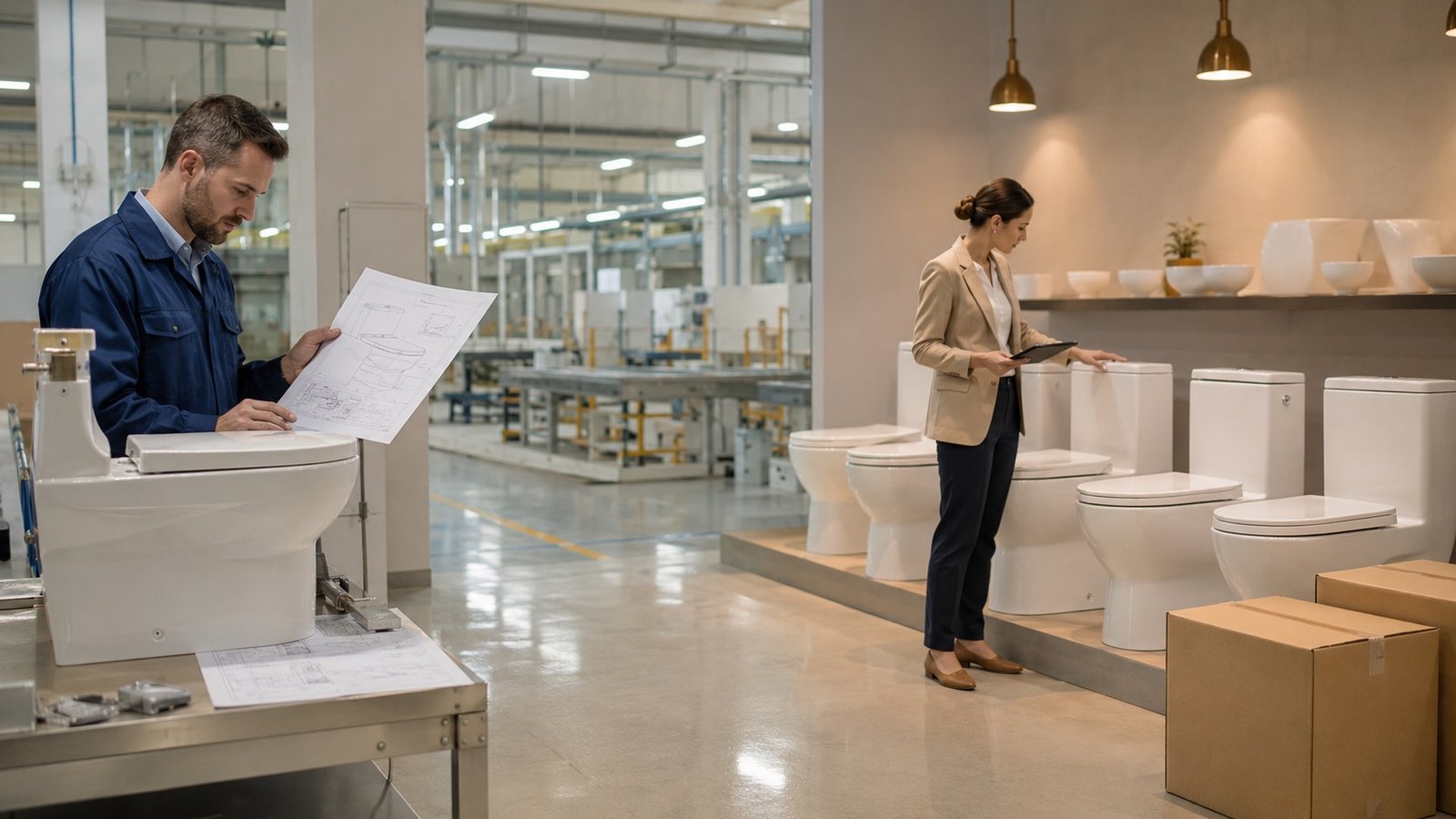
Every importer, distributor, or hotel brand that starts sourcing ceramic toilets from China eventually runs into the same fork in the road: OEM or ODM?
The two terms get thrown around almost interchangeably in supplier emails and Alibaba listings — but they represent two very different sourcing strategies, with different costs, timelines, and levels of control over your product. Picking the wrong one can mean paying for tooling you didn’t need, or losing months waiting for a design you could have had off the shelf.
This guide breaks down exactly what OEM and ODM mean in the sanitaryware industry, how they compare on the factors that actually matter to buyers, and how to decide which one fits your business.
Your design, their factory
The factory builds a toilet, basin, or bidet to your specifications — your bowl shape, your branding, sometimes your own mold. You bring the concept; they bring production capability, QC, and certification support.
You control:
- Bowl shape, trapway, flushing mechanism
- Glaze color and surface finish
- Branding: logo etching, packaging, manuals
- Functional add-ons (smart features, water-saving valves)
Their design, your label
The factory already owns a finished, tested design sitting in their catalog, tooled and ready. You select the model, request your logo and packaging, and it ships under your brand — often called private labeling.
You control:
- Logo placement and packaging
- Color and finish options already offered
- Which SKUs to select from the catalog
- Go-to-market timing — no mold wait
OEM vs ODM: Side-by-Side Comparison
| Factor | OEM | ODM |
|---|---|---|
| Design ownership | You own the design / IP | Factory owns the design |
| Customization level | Full — bowl shape, mold, features | Limited — color, logo, packaging |
| Typical MOQ | Higher (often 1–2 containers per SKU) | Lower — easier to test the market |
| Tooling cost | Yes, if a new mold is required | None — uses existing molds |
| Time to market | Longer (sampling, mold, testing) | Shorter — often ready to ship |
| Product exclusivity | High — hard to replicate | Lower — same design may go to others |
| Best for | Established brands, hotel chains, large-volume projects | New importers, market testing, private label startups |
Quick way to remember it: OEM = your design, their factory. ODM = their design, your label.
Which Model Should Your Business Choose?
- Launching a branded line and need to own the design long-term
- A hotel group with specific technical requirements (rough-in size, water pressure, ADA compliance)
- Planning large, recurring volumes where mold investment pays off
- Building a product that needs to stand apart in a project tender
- A new distributor or e-commerce brand testing what sells first
- Working with a limited budget or smaller initial order
- Looking to launch in weeks, not months
- Focused more on marketing and channel strategy than product design
A common middle path
Many buyers use both models across their catalog: an ODM standard one-piece toilet to fill out the range quickly and affordably, paired with one OEM “hero” product — like a custom smart toilet or signature basin — that carries the brand’s identity. This balances speed-to-market with genuine differentiation where it counts most.
Questions to Ask a Sanitaryware Factory Before Choosing
Whichever route you take, these questions will save you headaches later:
- Who owns the mold if I request custom tooling — can I take it to another factory later?
- What is the MOQ per SKU, and can it be split across colors or finishes?
- What certifications (CE, CUPC, WaterSense, WELS) does this design already hold, and what would a custom OEM design need to re-certify?
- How long is sampling to mass production, realistically — not the quoted best case?
- For ODM: is this exact design sold to other buyers in my target market, and can packaging meaningfully differentiate it?
How AIDIBATH Supports Both OEM and ODM Buyers
As a factory-direct manufacturer with 20+ production lines and 280,000㎡ of manufacturing space, AIDIBATH works with both sourcing models:
- OEM — custom mold development, private specifications, and branding for hotel groups, distributors, and importers building their own product line.
- ODM — a ready catalog of certified one-piece, two-piece, wall-hung, and smart toilets available for private labeling with fast turnaround and lower MOQs.
FAQ
Is ODM cheaper than OEM?
Generally yes, since ODM uses existing molds and skips engineering and tooling costs. OEM can cost more upfront but pays off in exclusivity and long-term brand control.
Can I switch from ODM to OEM later?
Yes — many brands start with ODM to test demand, then move a proven bestseller into an OEM custom version once volume justifies the mold investment.
Do OEM toilets take longer to certify?
Usually yes. A new design needs to go through certification testing (CE, CUPC, WaterSense, etc.) from scratch, while ODM designs typically already hold relevant certifications.
What’s the minimum order quantity for OEM sanitaryware?
It varies by factory and product, but expect higher MOQs than ODM — often around one to two containers per SKU — since the mold cost needs to be spread across the order.