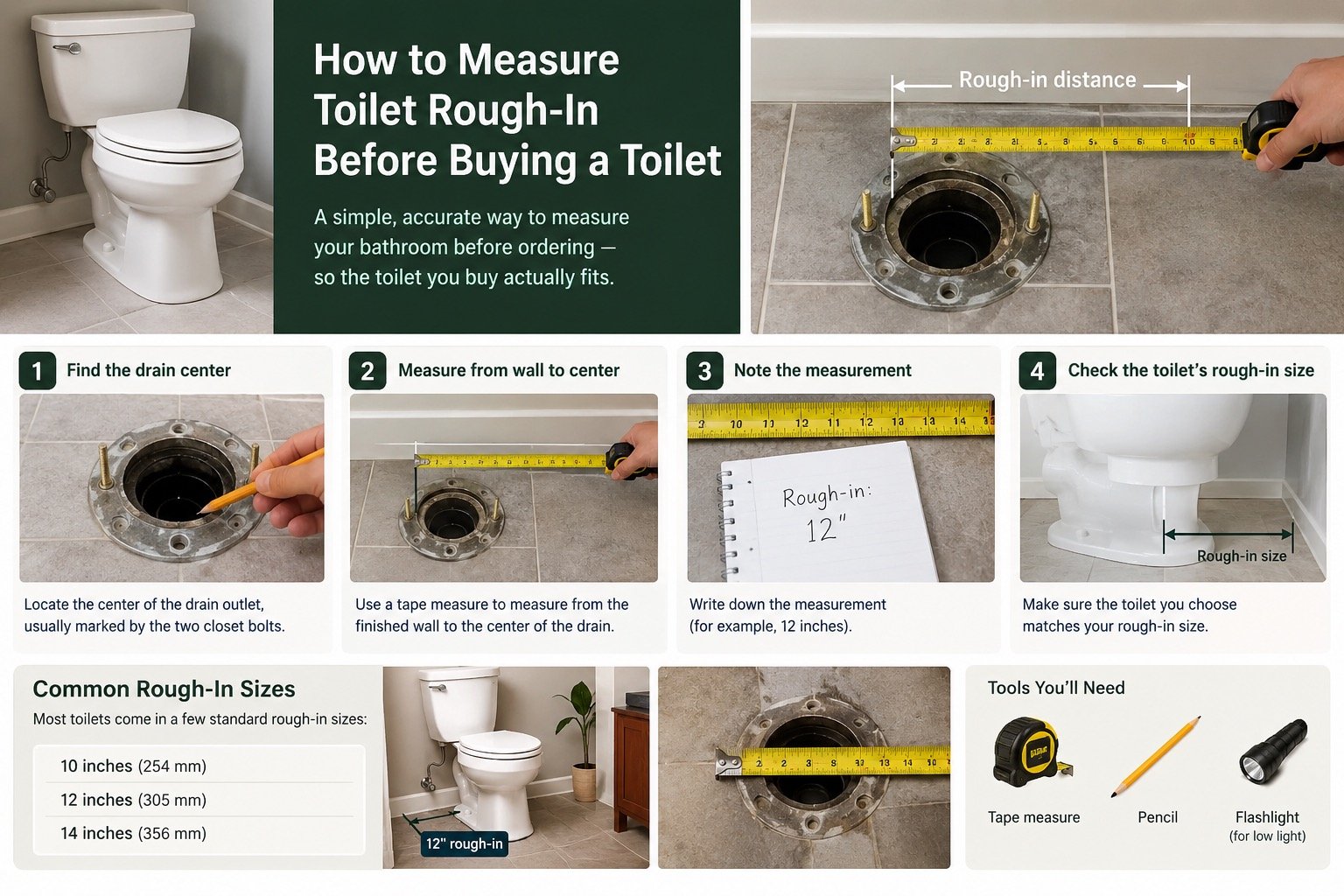
Before buying a new toilet, one measurement matters more than style, color, or flush technology: the rough-in distance. This single number determines whether a toilet will physically fit your existing drain and wall layout — get it wrong, and even the best-designed toilet won’t install correctly. Fortunately, measuring rough-in takes only a few minutes with a tape measure and no special tools. This guide walks through exactly what rough-in means, how to measure it correctly, and what to do with the number once you have it.
In this guide
What “rough-in” means · Tools you’ll need · Step-by-step measuring instructions · Common rough-in sizes · What to do with an odd measurement · Mistakes to avoid · FAQ
What Does “Rough-In” Mean?
The rough-in is the distance from the finished wall behind the toilet to the center of the drain outlet on the floor — usually marked by the two closet bolts that hold the toilet base in place. This measurement determines how far the toilet bowl needs to sit from the wall so that its outlet aligns correctly with the drain pipe below. Every toilet is manufactured for a specific rough-in size, so measuring accurately before ordering is the single most important step in avoiding a toilet that doesn’t fit.
Tools You’ll Need
Measuring rough-in doesn’t require anything specialized. A few basic items are enough to get an accurate reading:
A metal tape measure, ideally at least 12 inches (30 cm) long.
A pencil or piece of tape to mark reference points if needed.
Good lighting, or a flashlight, since the closet bolts can be partly hidden under an existing toilet base.
Step-by-Step: How to Measure Rough-In
Follow these steps to get an accurate rough-in measurement, whether you’re replacing an existing toilet or planning a new bathroom layout:
1. Locate the finished wall. Identify the wall directly behind the toilet — measure from the finished surface, not from the baseboard or any trim.
2. Find the closet bolts. These are the two bolts that secure the toilet base to the floor flange, usually visible on either side of the bowl’s base.
3. Measure to the center point. Place the tape measure at the wall and extend it to the center of the bolts (or the center of the drain flange if no toilet is currently installed).
4. Record the number. Round to the nearest half inch. This is your rough-in measurement.
5. Double-check clearance. Also measure the side-to-side space and the distance to any nearby fixtures, since some toilet bowls are longer or wider than others even with the same rough-in.
Tip: If a toilet is already installed, you can still measure accurately by running the tape measure from the wall to the center of the bolt caps at the base — there’s no need to remove the toilet first.
Common Rough-In Sizes
Most residential toilets are manufactured to fit one of three standard rough-in distances. Knowing which category your bathroom falls into narrows down compatible models quickly:
| Rough-In Size | How Common It Is | Typical Use |
|---|---|---|
| 10 inches | Less common | Compact or older bathrooms with limited space |
| 12 inches | Industry standard | Most residential and commercial bathrooms |
| 14 inches | Less common | Older homes and certain custom layouts |
A 12-inch rough-in is by far the most widely manufactured size, which is why it’s often treated as the default when a project specification doesn’t state otherwise. Always confirm the exact number rather than assuming, especially in older buildings or renovations.
What If Your Measurement Falls In Between?
Occasionally a measurement lands between standard sizes — for example, 11.5 or 12.5 inches. In most cases, a 12-inch rough-in toilet will still install correctly with a small amount of tolerance, since most floor flanges allow minor adjustment. However, if the difference is significant, it’s best to consult a plumber before purchasing, since forcing an incompatible rough-in can lead to an unstable installation or a toilet that sits too close to the wall or an adjacent fixture.
Best practice: For bulk orders or hospitality projects, confirm rough-in specifications across all units before finalizing a purchase — a mismatch discovered during installation is far more costly to fix than one caught during planning.
Common Measuring Mistakes to Avoid
A few small errors account for most rough-in measuring mistakes. Watching for these can save an unnecessary return or reinstallation:
- Measuring from the baseboard or trim instead of the finished wall surface.
- Measuring to the edge of the bolt instead of its center point.
- Rounding too aggressively, which can turn an 11.5-inch measurement into an incorrect 12-inch assumption.
- Forgetting to check side clearance and the space needed for the tank lid to open fully once installed.
Frequently Asked Questions
Do I need to remove my old toilet to measure rough-in?
No. You can measure from the wall to the center of the visible closet bolt caps at the base of the existing toilet without removing it.
Is 12-inch rough-in truly universal?
It’s the most common size and is often called the industry standard, but it is not universal. Older buildings and certain regions may use 10-inch or 14-inch rough-ins, so measuring is still necessary even when 12 inches seems likely.
Can rough-in size be changed during a renovation?
Yes, but it requires moving the drain flange and associated plumbing, which is a more involved job best handled by a licensed plumber rather than adjusted after the toilet has already been purchased.
Final Thoughts
Measuring toilet rough-in takes only a few minutes but prevents one of the most common and frustrating installation problems: ordering a toilet that simply doesn’t fit. By measuring from the finished wall to the center of the closet bolts, checking against standard sizes, and confirming clearance on all sides, buyers can order with confidence — whether furnishing a single bathroom or specifying units across an entire property.