When comparing toilets, terms such as siphonic flush, siphon jet, cyclone flush, vortex flushing and large flush valve often appear together. This can make toilet technology sound more complicated than it actually is.
The important point is that these terms do not always describe competing technologies. Some describe how waste leaves the bowl, while others describe how water is delivered or circulated inside it. A modern toilet may combine several of these principles in a single flushing cycle.
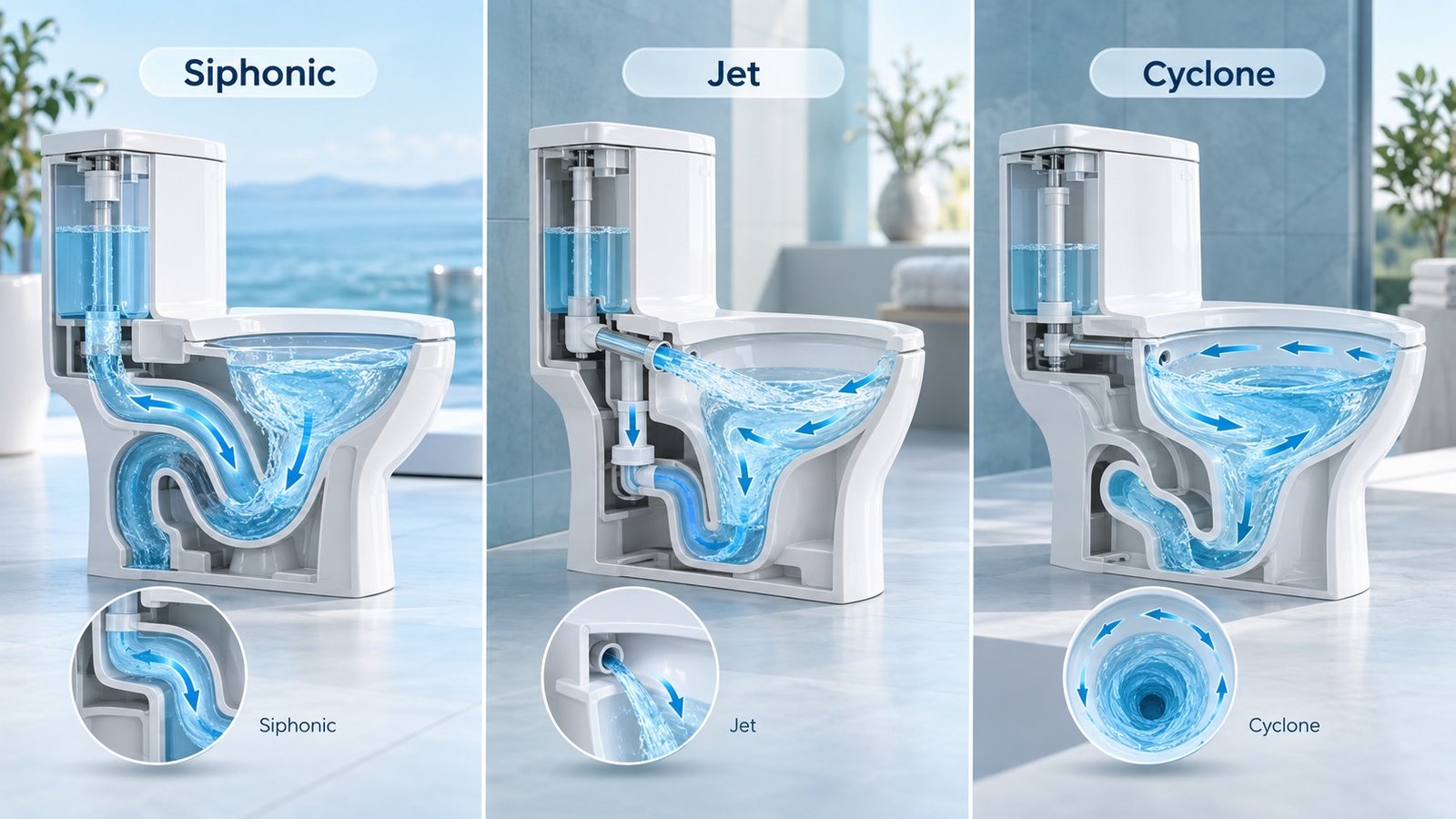
A siphonic system primarily describes how waste is evacuated through the trapway. A siphon jet directs concentrated water toward the trapway to help initiate that siphon. A cyclone or vortex system primarily describes how water circulates around the bowl to improve surface rinsing. Therefore, a toilet can theoretically use both siphonic evacuation and cyclone-style bowl washing.
1. First, What Does the Flush Valve Actually Do?
Before comparing siphonic, jet and cyclone systems, it helps to separate the flush valve from the rest of the toilet flushing system.
In a conventional tank toilet, the flush valve is the opening and valve assembly that releases stored water from the tank when the user activates the flush. Once opened, water moves rapidly from the tank into channels inside the ceramic bowl.
The valve itself does not determine the entire flushing method. It is one component in a larger hydraulic system that includes:
- flush valve diameter and opening speed;
- tank water volume;
- rim channels and water outlets;
- siphon jets or directional nozzles;
- bowl geometry;
- trapway shape;
- water surface level;
- drainage and venting conditions.
2. What Happens During a Toilet Flush?
A gravity-fed toilet performs several hydraulic tasks in only a few seconds.
The flush valve opens and allows stored water to leave the tank rapidly.
Stage 2 — Water DistributionInternal passages direct water toward the rim, bowl, jet outlets or other engineered channels.
Stage 3 — Bowl CleaningWater moves across the ceramic surface to loosen residue and direct waste toward the outlet.
Stage 4 — Waste EvacuationGravity, momentum and—in siphonic toilets—siphon action move bowl contents through the trapway.
Stage 5 — RefillThe flush cycle ends, the tank refills and the correct standing water level is restored in the bowl.
A good toilet must perform all of these tasks with a limited quantity of water. That is why water direction and velocity can be just as important as total flush volume.
3. Siphonic Flush: Using the Trapway to Create Siphon Action
A siphonic toilet is designed so that rapidly entering water fills the curved trapway and establishes a continuous water column. Once the hydraulic conditions are correct, siphon action helps draw water and waste through the trapway.
Rather than relying entirely on water physically pushing waste forward, the system uses the geometry of the bowl and trapway as part of the evacuation process.
How a Siphonic Flush Works
At the beginning of the flush, water enters the bowl quickly. As the trapway fills, air is displaced. Once siphon action develops, the bowl water level drops rapidly as the contents are drawn through the internal passage.
Near the end of the cycle, air enters the trapway again and breaks the siphon. Fresh water then restores the normal bowl water level.
Key Engineering Advantages
- Effective waste evacuation when the trapway and water delivery system are correctly matched.
- Can maintain a relatively substantial standing water surface.
- Can be combined with modern water-saving flushing designs.
- Can work together with rim jets, siphon jets and vortex-style bowl washing.
What Can Affect Performance?
Siphonic performance depends heavily on hydraulic balance. A poorly designed trapway, insufficient water velocity, restricted passages or incorrect tank water level can prevent the siphon from developing efficiently.
4. Siphon Jet Flush: Concentrating Water Where It Matters
The term jet flush can describe several water-delivery arrangements, but in siphonic toilets it commonly refers to a siphon jet.
A siphon jet is typically positioned near the lower area of the bowl and directs a concentrated stream of water toward the trapway entrance.
Why Add a Jet?
Instead of sending all available water around the upper rim, part of the flush volume is delivered directly toward the outlet. This increases water movement in the region where siphon formation needs to begin.
The jet can therefore help fill the trapway quickly and accelerate waste evacuation.
Siphonic vs Siphon Jet: Are They Different?
Not necessarily.
This is one of the most common sources of confusion when comparing toilets. A siphon-jet toilet is usually still a type of siphonic toilet.
Think of the relationship this way:
Siphon jet = a water-delivery feature that helps activate that evacuation principle.
As a result, comparing “siphonic” and “jet” as if they were always mutually exclusive technologies can be misleading.
5. Cyclone Flush: Creating Rotational Bowl-Washing Action
Cyclone, vortex or tornado-style flushing usually describes a different part of the flushing process: how water travels around the inside surface of the bowl.
Instead of relying on many small rim holes that discharge water almost vertically, cyclone-style designs use strategically positioned outlets or nozzles to introduce water at an angle.
This creates a strong circular or spiral water path around the bowl.
What Is the Purpose of Cyclonic Water Flow?
Its primary advantage is bowl coverage. Rotational water movement can sweep across a larger area of the ceramic surface before reaching the outlet.
This approach is particularly compatible with modern rimless or reduced-rim bowl designs because fewer, larger outlets can be engineered to control the direction of the flush.
Does Cyclone Flushing Replace Siphonic Flushing?
Not necessarily.
Cyclonic action mainly describes bowl washing and water circulation. After that water reaches the lower bowl, waste still needs to move through the trapway.
Depending on the toilet design, this evacuation stage may use siphonic action or another drainage configuration.
6. Siphonic, Jet and Cyclone Flush Compared
| Feature | Siphonic Flush | Siphon Jet | Cyclone / Vortex Flush |
|---|---|---|---|
| Main Function | Waste evacuation | Assists siphon initiation | Bowl washing and water distribution |
| Basic Principle | Creates siphon action in the trapway | Directs concentrated water toward the trapway | Creates circular or spiral water movement |
| Primary Design Area | Trapway and bowl geometry | Lower bowl / trapway entrance | Bowl wall and rim area |
| Primary Objective | Move waste through the outlet efficiently | Establish evacuation flow rapidly | Improve surface coverage during rinsing |
| Can It Be Combined With Other Systems? | Yes | Yes | Yes |
| Performance Depends On | Trapway geometry, water flow and bowl design | Jet size, angle, flow rate and trapway design | Nozzle position, angle, bowl shape and water velocity |
7. Which Toilet Flushing System Is Better?
There is no universal winner because these technologies perform different jobs.
Siphonic
Best understood as an evacuation strategy. Its effectiveness depends strongly on how well the bowl, trapway and incoming water flow are engineered as a complete hydraulic system.
Siphon Jet
Useful when designers want to direct part of the flush water immediately toward the trapway and accelerate siphon formation.
Cyclone
Primarily focused on distributing water around the bowl and improving surface rinsing through controlled rotational flow.
A high-performance toilet may therefore combine a fast-opening flush valve, strategically positioned bowl outlets, cyclonic washing and siphonic evacuation rather than choosing only one technology.
8. What Actually Determines Toilet Flushing Performance?
Marketing names can help explain a design, but professional buyers should look beyond the name of the flushing technology.
The valve must release the required quantity of water quickly enough for the bowl’s hydraulic channels to operate as designed.
Water should be directed where it performs useful work rather than simply increasing turbulence without improving bowl washing or waste removal.
The internal passage must balance waste clearance, water flow and—in siphonic designs—the conditions required to establish reliable siphon action.
The slope, depth and contour of the bowl influence how water circulates and how efficiently waste reaches the outlet.
Outlet location and angle determine whether water reaches critical surfaces and whether rotational or directional flow develops as intended.
Lower water consumption does not automatically mean weaker flushing. Efficient modern toilets are designed to extract more hydraulic work from a controlled volume of water.
Ceramic dimensional consistency, internal passage formation and component matching are important because small changes in hydraulic geometry can affect actual flushing behavior.
9. What Should Buyers Compare Before Selecting a Toilet?
For homeowners, distributors, contractors, developers and hotel projects, the flushing-system name should be only one part of the evaluation.
| Item to Check | Why It Matters |
|---|---|
| Rated flush volume | Determines the amount of water available during each flush cycle. |
| Flush valve configuration | Influences how rapidly water leaves the tank. |
| Trapway design | Affects both waste passage and hydraulic performance. |
| Bowl-washing system | Determines how effectively water covers the ceramic surface. |
| Jet or nozzle arrangement | Controls water direction and velocity. |
| Drainage compatibility | The toilet must match local installation and plumbing conditions. |
| Flush testing | Actual performance data is more useful than relying only on marketing terminology. |
10. A Common Mistake: Choosing a Toilet by Flush Valve Size Alone
Larger flush valves are often promoted as evidence of stronger flushing. A larger opening can allow tank water to enter the bowl more rapidly, but valve diameter alone does not determine performance.
If downstream water channels, nozzles, bowl geometry or the trapway are poorly matched, increasing the valve opening does not automatically create an efficient flush.
The best-performing designs coordinate the flush valve, water channels, bowl geometry and trapway so that a limited quantity of water performs several tasks in sequence: washing the surface, moving waste toward the outlet and completing evacuation.
11. Frequently Asked Questions
Is a siphon jet toilet the same as a siphonic toilet?
A siphon-jet toilet is generally a form of siphonic toilet. The siphon jet is a concentrated water outlet designed to help establish flow toward the trapway, while siphonic describes the broader waste-evacuation principle.
Is cyclone flushing stronger than siphonic flushing?
They should not be compared only in terms of strength because they describe different aspects of the flushing process. Cyclone-style systems emphasize rotational bowl washing, while siphonic systems describe how waste is evacuated through the trapway.
Can a toilet have both cyclone and siphonic flushing?
Yes. A toilet can use rotational water flow to wash the bowl while also relying on siphonic action to evacuate water and waste through the trapway.
Does a larger toilet flush valve always mean better flushing?
No. A larger valve can increase the rate at which water leaves the tank, but effective flushing also depends on water-channel design, bowl geometry, jets, trapway geometry and total system balance.
Does cyclone flushing use more water?
Not inherently. Cyclone describes how water is directed around the bowl rather than specifying a fixed flush volume. Water consumption depends on the complete toilet design and its rated flush volume.
Are water-saving toilets weaker than conventional toilets?
Not necessarily. Modern toilet engineering focuses on controlling water velocity, direction and timing so that a reduced volume of water can still provide effective bowl washing and waste evacuation.
Which flushing system is best for a hotel or apartment project?
Project buyers should compare actual flush reliability, maintenance requirements, water consumption, installation compatibility and manufacturing consistency rather than selecting toilets solely by the name of the flushing technology.
Final Thoughts
Understanding toilet flushing technology becomes much easier once the functions are separated.
Siphonic flushing primarily concerns how water and waste move through the trapway. A siphon jet concentrates water near the outlet to help establish that flow. Cyclone or vortex flushing focuses primarily on how water circulates around the bowl to improve surface coverage.
These technologies can complement rather than compete with one another.
For that reason, buyers should avoid judging toilet performance from a single label such as “jet,” “cyclone” or “large flush valve.” Reliable flushing comes from the complete hydraulic design: the valve, water passages, bowl, jets and trapway must all work together.
Understanding those relationships makes it much easier to compare toilet specifications intelligently and choose products based on engineering rather than marketing terminology.