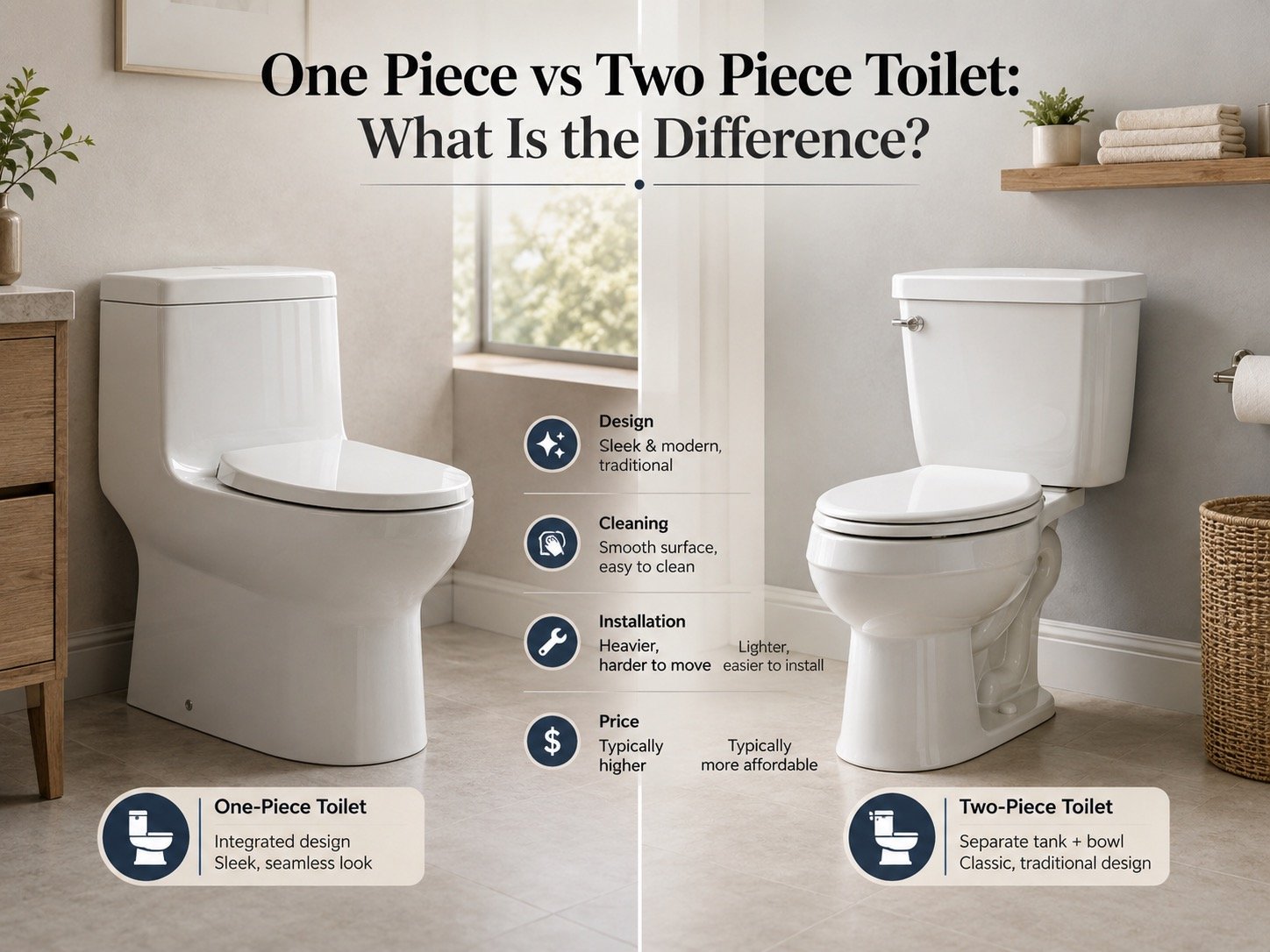
When choosing a new toilet, you will often see two common configurations: one piece toilets and two piece toilets.
Both perform the same basic function, but the way the tank and bowl are constructed affects cleaning, appearance, installation, handling, maintenance, and cost.
The Main Difference
A one piece toilet combines the tank and bowl into one integrated ceramic body. A two piece toilet has a separate tank and bowl that are connected during installation.
One Piece vs Two Piece Toilet at a Glance
| Feature | One Piece | Two Piece |
|---|---|---|
| Construction | Tank and bowl integrated | Separate tank and bowl |
| Cleaning | Generally easier | More joints to clean |
| Handling | Heavier as one complete unit | Can be moved in separate sections |
| Appearance | Smooth and streamlined | Traditional or modern |
| Price | Often higher | Often more economical |
1. Construction: One Body or Two?
One Piece Toilet
The tank and bowl are formed into a single ceramic fixture. There is no external joint where a separate tank needs to be bolted onto the bowl.
Two Piece Toilet
The tank and bowl are manufactured separately. During installation, the tank is positioned on the bowl and secured using the appropriate bolts and seals.
2. Which Is Easier to Clean?
This is one of the clearest differences between the two configurations.
One piece toilets usually have an advantage. The smooth transition between the tank and bowl eliminates the external tank-to-bowl gap where dust, moisture, and dirt may collect.
A two piece toilet has more joints around the tank connection. These areas are still easy to maintain with regular cleaning, but they may require slightly more attention.
A skirted trapway can further simplify cleaning on either toilet type.
3. Which Is Easier to Install?
The answer depends on what part of installation you consider easier.
| Installation Factor | Difference |
|---|---|
| Assembly | A one piece toilet does not require separate tank-to-bowl assembly. |
| Lifting | A two piece toilet can usually be carried as separate tank and bowl sections. |
| Positioning | A heavier one piece fixture may require more careful handling. |
Practical Difference: A one piece toilet has fewer assembly steps, while a two piece toilet is usually easier to carry because the tank and bowl can be handled separately.
4. Which Takes Up Less Space?
A one piece toilet often has a streamlined profile, and some models are designed specifically for compact bathrooms.
However, one piece does not automatically mean smaller.
- Overall length
- Overall width
- Tank height
- Bowl height
- Rough-in
- Door and vanity clearance
A compact two piece toilet may occupy less space than a large one piece model, so dimensions matter more than configuration alone.
5. Which Looks More Modern?
One piece toilets are commonly associated with modern bathroom design because the continuous ceramic body creates fewer visible joints.
Two piece toilets offer a broader traditional appearance, although many modern two piece models also use clean lines, concealed trapways, and contemporary shapes.
Appearance is therefore largely a matter of bathroom style rather than performance.
6. Does One Piece or Two Piece Flush Better?
Neither configuration automatically flushes better.
Flushing performance depends much more on the internal engineering of the toilet.
| Performance Factor | Why It Matters |
|---|---|
| Flush Valve | Controls water release speed. |
| Trapway | Influences waste movement. |
| Bowl Geometry | Controls water distribution. |
| Flush Technology | May use siphonic, washdown, dual-flush, or other designs. |
A well-engineered two piece toilet can perform just as well as a one piece toilet, and vice versa.
7. What About Repairs and Replacement?
Most normal toilet maintenance involves replaceable internal components such as fill valves, flush valves, seals, buttons, and seats.
If the ceramic body of a one piece toilet is seriously damaged, the integrated fixture generally needs to be treated as one complete unit. With some two piece toilets, a compatible tank or bowl may be replaceable separately.
Availability depends on the particular model, so replacement-part support should always be considered when choosing a toilet.
Which Toilet Should You Choose?
Choose a One Piece Toilet If You Prefer:
- A smooth, integrated appearance
- Easier exterior cleaning
- Fewer visible joints
- Contemporary bathroom styling
Choose a Two Piece Toilet If You Prefer:
- More economical options
- Easier transportation in separate sections
- A wide range of conventional designs
- Potentially easier separate ceramic replacement
Frequently Asked Questions
Is a One Piece Toilet Better Than a Two Piece Toilet?
Not automatically. One piece toilets are generally easier to clean and have a seamless appearance, while two piece toilets often provide good value and easier handling during installation.
Do One Piece Toilets Take Up Less Space?
Some do, but not all. Always compare the actual dimensions and rough-in rather than assuming that one piece construction means a smaller toilet.
Do Two Piece Toilets Leak More?
A two piece toilet has an additional tank-to-bowl connection that uses seals and mounting hardware. Proper installation and maintenance are important for either toilet type.
Which Toilet Has Better Flushing Performance?
Neither configuration has an automatic advantage. Flush performance depends on the flush valve, water flow, bowl geometry, trapway, and overall engineering.
The Bottom Line
The main difference between a one piece vs two piece toilet is construction.
A one piece toilet combines the tank and bowl into a seamless ceramic body, making it easier to clean and giving it a streamlined appearance. A two piece toilet uses separate tank and bowl sections, making it easier to transport and often more economical.
Neither design is automatically better at flushing or saving water. When choosing between them, compare the toilet’s dimensions, rough-in, bowl shape, flushing technology, water consumption, installation requirements, and maintenance needs — not just the number of pieces.