A toilet sold in the United States has to satisfy more than just plumbing code common sense — it has to meet a specific stack of technical standards and third-party certifications before it can legally reach a store shelf, a distributor’s warehouse, or a construction project. These requirements cover everything from flush performance and water efficiency to accessibility and lead content. For manufacturers, importers, and specifiers, understanding this landscape isn’t optional paperwork; it directly determines whether a product can be sold, installed under local plumbing codes, or specified on a commercial project at all.
In this guide
Why certification matters · ASME A112.19.2 / CSA B45.1 performance standard · IAPMO and UPC listing · EPA WaterSense water efficiency · Accessibility compliance (ADA / ANSI A117.1) · Lead-free rules and performance testing · FAQ
Why Certification Matters
In the US, plumbing fixtures are regulated at multiple levels: federal water-efficiency law, state-level codes (California in particular has some of the strictest requirements in the country), and local building departments that enforce the Uniform Plumbing Code (UPC) or International Plumbing Code (IPC). A toilet that lacks the required certifications can be rejected by a plumbing inspector, refused by a distributor, or pulled from a project specification — regardless of how well it performs. For any manufacturer or importer targeting the US market, certification isn’t a marketing add-on; it’s a prerequisite for market access.
ASME A112.19.2 / CSA B45.1: The Core Performance Standard
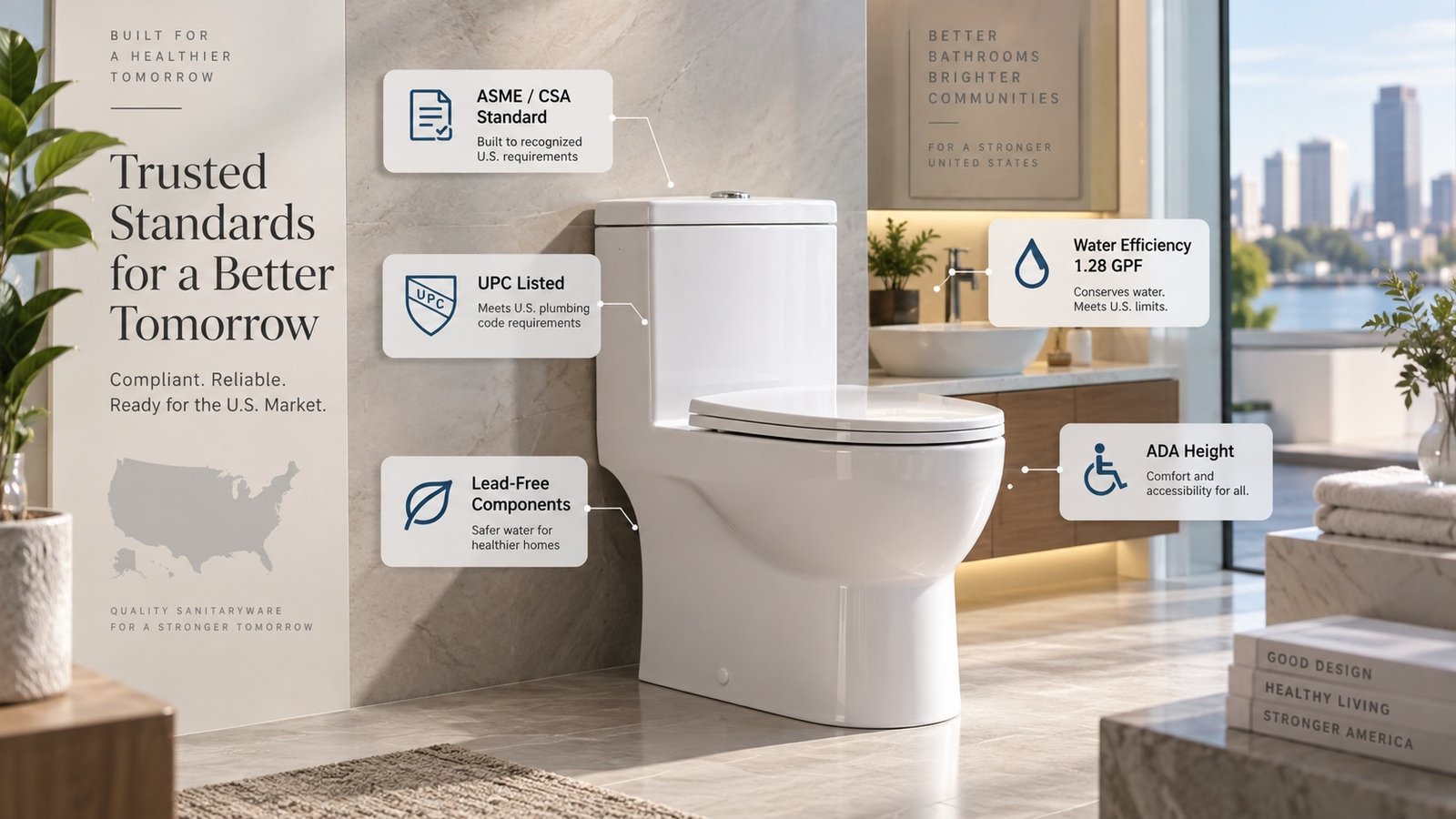
The foundational standard for ceramic toilets in North America is the joint ASME A112.19.2 / CSA B45.1 standard, published together by the American Society of Mechanical Engineers and the CSA Group. This standard sets the baseline requirements for a toilet’s construction, materials, and flushing performance, covering everything from trap seal depth to ball-and-media waste removal testing. Toilets with dual-flush functionality must additionally meet ASME A112.19.14, which addresses the specific performance requirements of a two-mode flush system. Virtually every legitimately certified toilet sold in the US references this standard on its specification sheet, and it forms the technical basis that other certifications, like IAPMO listing, are built on top of.
IAPMO and UPC Listing: Plumbing Code Compliance
Meeting the ASME/CSA performance standard is only half the equation — the product also needs independent verification that it actually does. This is where IAPMO (the International Association of Plumbing and Mechanical Officials) comes in. Through its testing division, IAPMO R&T, products are tested against the UPC Standards, which bundle together the relevant ASME/CSA and EPA WaterSense requirements into a single certification process. A toilet that carries the UPC mark (or the cUPC mark for products also certified for the Canadian market) has been independently tested and listed, which most local plumbing inspectors and building departments recognize and require before allowing installation.
Buyer tip: Look for “IAPMO Listed” or a visible UPC mark on the product or spec sheet. This single certification is often the difference between a toilet that clears a plumbing inspection and one that doesn’t.
EPA WaterSense: Federal and State Water Efficiency Rules
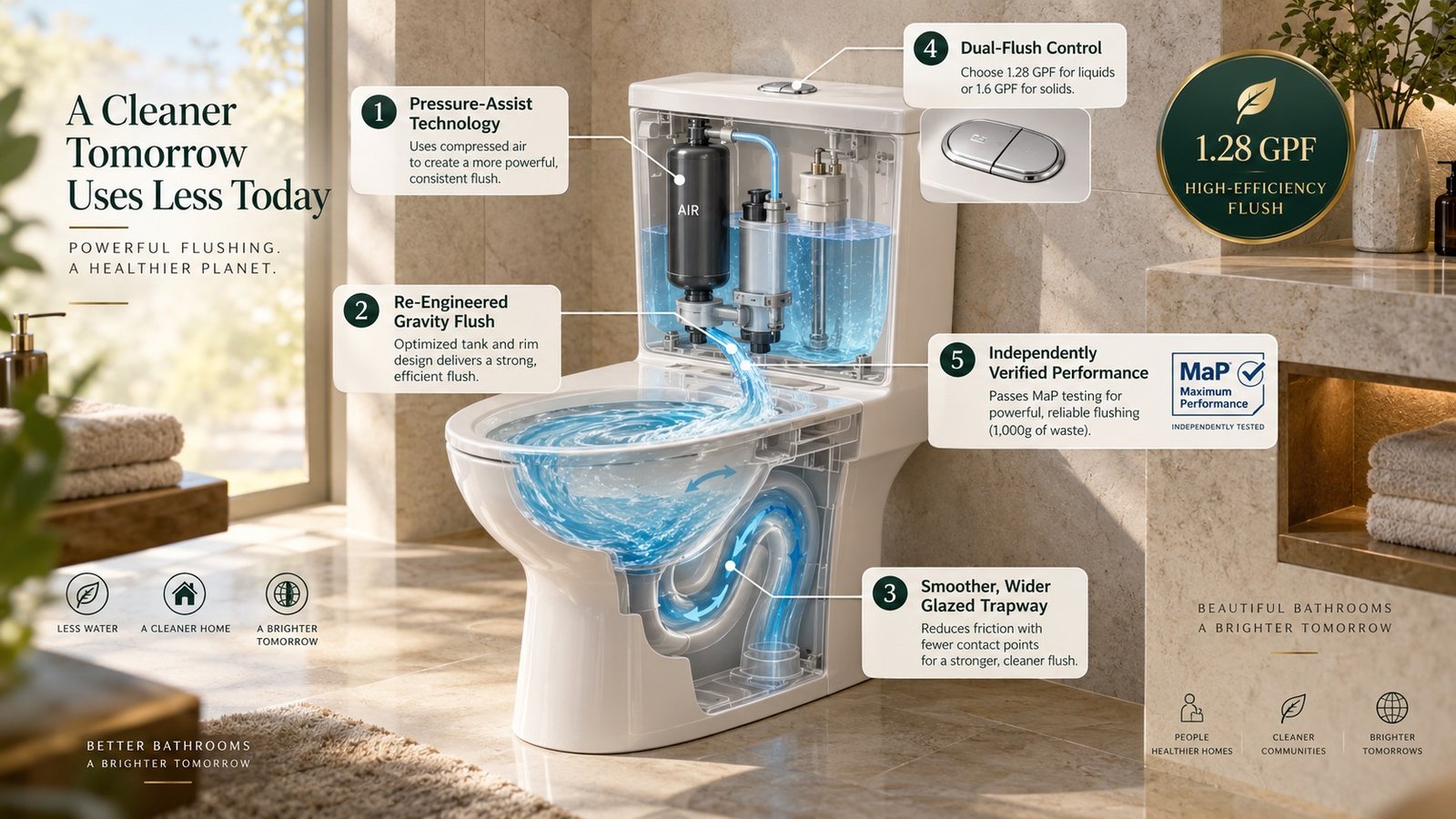
Federal law under the Energy Policy Act sets a nationwide maximum of 1.6 gallons per flush (gpf) for toilets sold in the US. Beyond that federal floor, the EPA’s voluntary WaterSense program certifies toilets that perform even more efficiently, at 1.28 gpf or less, while still meeting minimum flushing performance requirements. Several states — California among the strictest — go further and legally require toilets sold within the state to meet the 1.28 gpf WaterSense threshold, not just the older 1.6 gpf federal minimum. For dual-flush toilets specifically, WaterSense’s updated specification now requires both the full-flush and reduced-flush modes to independently meet the 1.28 gpf cap, closing a previous loophole that allowed a full flush above that limit as long as the averaged volume qualified.
Accessibility Compliance: ADA and ANSI A117.1
For toilets installed in commercial buildings, public facilities, and many multi-family residential projects, accessibility requirements come into play. ANSI A117.1 is the technical accessibility standard that most state building codes reference, covering specifications such as bowl height, clearance space, and grab bar compatibility. The Americans with Disabilities Act (ADA) sets the broader civil rights requirement that public accommodations provide accessible facilities, and ANSI A117.1 compliance is generally how that requirement is met in practice. Manufacturers targeting commercial, hospitality, or institutional projects typically offer both standard-height and ADA-compliant “comfort height” models to cover both residential and code-mandated commercial installations.
Lead-Free Rules and Independent Performance Testing
Any toilet component that contacts the potable water supply — most notably the fill valve — must comply with US lead-free requirements. NSF/ANSI 372 is the standard used to verify that these components meet the “lead-free” threshold defined under the federal Safe Drinking Water Act. Separately, products sold in California must comply with Proposition 65, which requires a warning label if a product can expose users to trace amounts of chemicals, including lead, that the state has identified as a health concern — this labeling requirement applies broadly across plumbing fixtures and is not necessarily a sign that a product is non-compliant elsewhere. Beyond mandatory certifications, many manufacturers also submit toilets for MaP (Maximum Performance) testing, a widely referenced but voluntary program that scores how much solid waste a toilet can clear in a single flush. While not a legal requirement, a strong MaP score is often used by specifiers and reviewers as an independent, comparable measure of real-world flushing performance.
Note for bulk buyers: A Proposition 65 warning label is standard practice across most vitreous china plumbing fixtures sold in California and does not by itself indicate a compliance problem — but confirming lead-free certification on the fill valve and other water-contact components is still worth verifying directly with the manufacturer.
Frequently Asked Questions
Is WaterSense certification mandatory to sell a toilet in the US?
Not at the federal level — the mandatory federal minimum is 1.6 gpf under the Energy Policy Act. However, several states, including California, legally require the stricter 1.28 gpf WaterSense threshold for toilets sold within the state.
What’s the difference between UPC and cUPC certification?
Both are issued by IAPMO. The UPC mark certifies a product for the US market, while the cUPC mark certifies the same product for both the US and Canadian markets, since Canada has its own parallel set of CSA-referenced requirements.
Do all commercial toilets need to be ADA compliant?
Not universally, but public accommodations and many commercial facilities are legally required to provide a certain number of ADA-compliant, accessible fixtures under ANSI A117.1, so most commercial specifications call for at least a portion of installed units to meet these requirements.
Final Thoughts
Selling or specifying a toilet in the US means clearing several distinct layers of compliance: the ASME A112.19.2/CSA B45.1 performance standard, independent IAPMO/UPC listing, EPA WaterSense water-efficiency thresholds, accessibility requirements under ANSI A117.1 where applicable, and lead-free certification for water-contact components. None of these are optional formalities — each one affects whether a toilet can pass a plumbing inspection, be legally sold in a given state, or be specified on a commercial project. Confirming these certifications upfront, rather than after a shipment or installation is already underway, is the most reliable way to avoid costly compliance issues down the line.